Thinking about Keeping Bees?

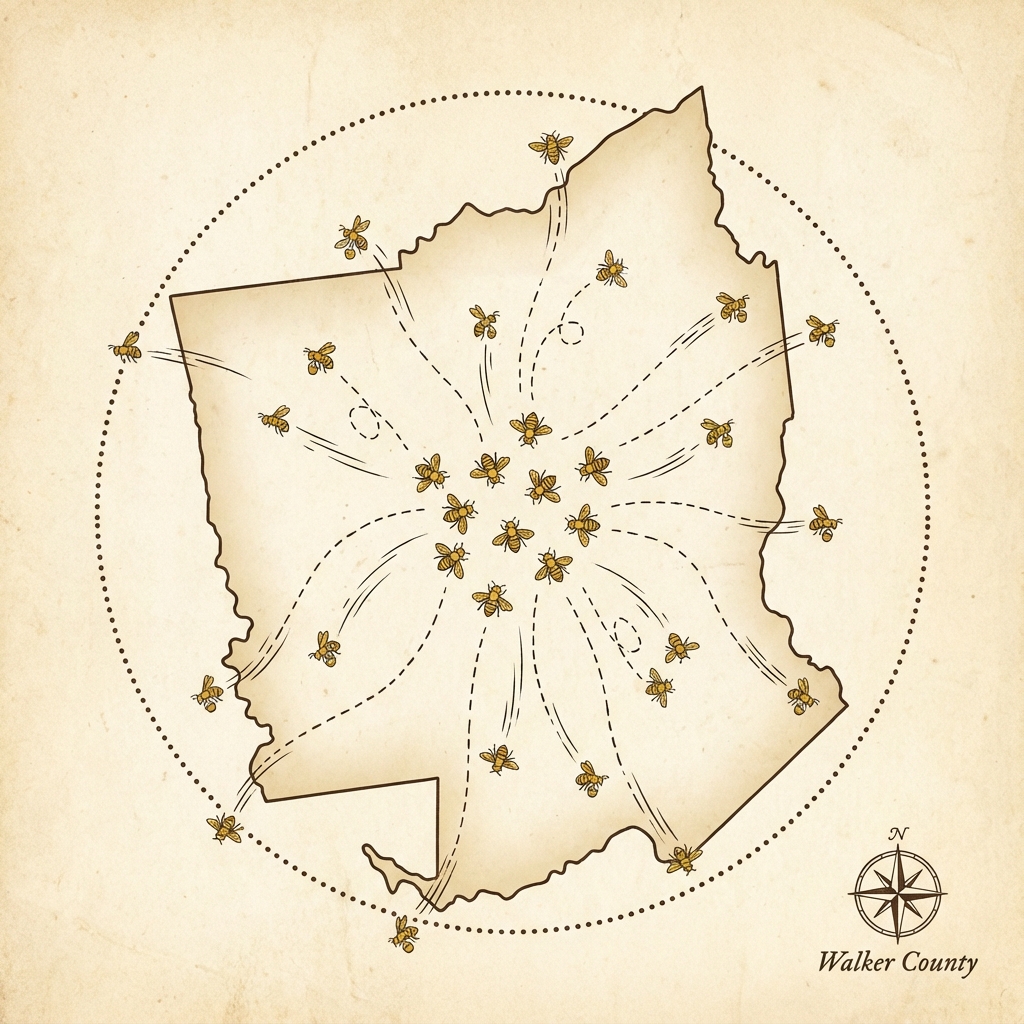
Bee Map of Walker County

As beekeepers, we spend half our time worrying about mites and the other half staring at the treeline, wondering, ~”What is blooming out there?”~

Success in the hive is 90% location. To help our members understand what makes a site “gold” (or a dud), we conducted a deep-dive case study on a representative spot right here in central Walker County. We looked at everything—from satellite forage maps to creek beds and potential bear sightings—to give you a blueprint of what to look for in your own backyard.

Here is the “Anatomy of a Walker County Texas Apiary.”

 The Spot: Central Walker County Texas

Coordinates: 30.602° N, 95.555° W

The Vibe: Rural, mixed pine/hardwood, open pasture.

The Climate: USDA Zone 8b (aka: Mild winters and the classic East Texas steam bath in July).

We picked a spot about 8 miles south of Huntsville. It’s that classic Piney Woods mix we all know and love: a patchwork of managed pines, bottomland hardwoods along the creeks, and cattle pastures.

 🐝 The Commute (Flight Range)

We looked at the “Grocery Store” radius—the 1-mile ring around the hives where your bees will do 90% of their shopping.

~ The Menu: It’s a buffet. The site is 50% forest and 35% pasture.

~ The Main Courses: Your bees are feasting on Yaupon Holly and Dewberry in the spring, followed by the controversial-but-productive Chinese Tallow and Rattan Vine in early summer.

~ The Sides: Pasture clover and rural residential gardens add variety.

The “Secret Weapon”: This site sits near the Sam Houston National Forest. This is a massive, pesticide-free reservoir of forage. If you are keeping bees near the National Forest boundary, count yourself lucky—you have a protected forage buffer that few other places can match.

 💧 The Watering Hole

In Walker County, if you walk downhill long enough, you’ll hit water. This site is no exception. With unnamed spring-fed creeks to the east and west, plus stock tanks on neighboring farms, the bees here have perennial water sources.

~ Beekeeper Tip: Even with creeks nearby, put a water source in your apiary. It keeps your bees out of the neighbor’s swimming pool and saves them energy on hot days!

 🗓️ The Calendar: Feast and Famine

If you set up hives here, your year looks like a rollercoaster:

1. The Boom (March-June): Get your supers ready. Between the Willow, Tallow, and Privet, the nectar flow is strong.

2. The Bust (July-August): Welcome to the Summer Dearth. When the heat hits and the rain stops, the nectar dries up. You might need to feed during the “dog days” to keep them going.

3. The Recovery (Sept-Oct): Goldenrod and Asters to the rescue! This fall flow is critical for winter stores.

 ⚠️ The Hazards: Bears, Skunks, and Sprays

It’s not all milk and honey. We assessed the risks for this location:

~ The Usual Suspects: Skunks and raccoons are everywhere in this area. Stand height matters. Keep those hives 18 inches up to stop scratching at the entrance.

~ The “Big” Risk: Because this site is near the National Forest, Black Bears are a genuine (if rare) possibility. In this specific zone, an electric fence isn’t paranoid—it’s good insurance.

~ Chemicals: The risk here is low. No Superfund sites, no heavy industry. The only thing to watch? The mosquito truck. If you are near a subdivision, get on the county notification list for spray days.

 🏆 The Verdict

Is this a good spot for bees? Absolutely.

We rate this location as Excellent. The combination of National Forest proximity, diverse forage, and low industrial risk makes it a honey-producing powerhouse. The biggest challenges—the summer dearth and the wildlife—are things we can manage with good beekeeping practices.

Your Turn:

Pull up Google Maps and look at your apiary. Do you have that mix of pasture and woods? Are you protected from the wind? Where is the nearest water? Understanding your land is the first step to a record harvest.

~Happy Beekeeping, Walker County Beekeepers Association!~

Need help assessing your spot?
Come chat with us at the next WCBA meeting!
Click here to see our upcoming Events

WCBA Member
Experience and Interest Survey 2026

Your input will be brought to our first board meeting to develop a plan that best serves our community.
Survey responses will also be highlighted in the December 2025 Newsletter and discussed at the January 2026 Meeting.