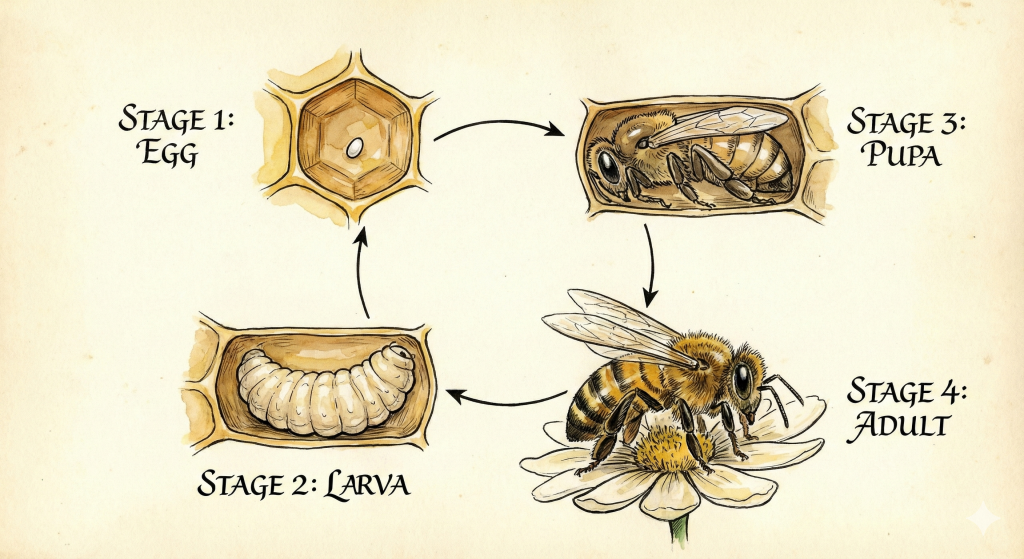
Honeybee Lifecycle

HoneyBee Lifecycle it’s a journey of incredible transformation

Let’s dive into the four main stages:

1. The Egg Stage (3 Days)

  • It all begins here! The queen bee is the only one who lays eggs. She carefully places each tiny, white, rice-grain-shaped egg at the bottom of a hexagonal wax cell.
  • Fertilized vs. Unfertilized: If the egg is fertilized, it will develop into a female bee (either a worker or a queen). If it’s unfertilized, it will develop into a male bee, called a drone.
  • For three days, the egg sits snugly in its cell.

2. The Larva Stage (5-6 Days for Workers)

  • Hungry, hungry caterpillar! After three days, the egg hatches into a tiny, white, legless, C-shaped larva. It looks a bit like a small grub or maggot.
  • Feeding Frenzy: This is the most rapid growth stage! Nurse bees constantly feed the larva.
    • For the first few days, all larvae are fed royal jelly (a super-nutritious secretion from nurse bees).
    • After that, worker and drone larvae switch to a diet of “bee bread” (a mixture of pollen and honey/nectar).
    • However, if a larva is destined to become a queen, she will continue to be fed royal jelly exclusively and copiously throughout her larval stage – this is what makes her a queen!
  • The larva grows incredibly fast, molting its skin five times as it gets bigger.

3. The Pupa Stage (7-14 Days for Workers)

  • The Big Change! Once the larva is fully grown, it stretches out in its cell, and the worker bees cap the cell with a layer of wax and pollen. Inside this sealed cell, the larva spins a thin cocoon around itself.
  • Metamorphosis in Action: This is where the magic happens! The pupa doesn’t eat or move, but incredible changes are taking place internally. Its body transforms: legs, wings, eyes, and all the adult bee structures begin to form and differentiate.
  • It starts to look more and more like an adult bee, just pale and soft.

4. The Adult Stage (Lifespan Varies)

  • Breaking Free! Once fully developed, the adult bee chews its way out of the wax capping of its cell and emerges into the hive!
  • Roles and Lifespans:
    • Worker Bee (Female): The most common bee. In summer, they live for about 5-6 weeks, working themselves tirelessly. In winter, they can live for several months. They perform all the tasks of the hive: nursing, foraging, guarding, cleaning, building comb, etc.
    • Drone (Male): Live for a few weeks to a few months. Their main purpose is to mate with a queen from another colony. They are usually kicked out of the hive in the fall.
    • Queen Bee (Female): The longest-lived bee, she can live for 1-5 years (sometimes even more!). Her primary role is to lay eggs and ensure the colony’s continuity.

So, from a tiny egg to a fully formed bee, the entire process for a worker bee usually takes about 21 days (3 days egg, 6 days larva, 12 days pupa). Queens develop faster (around 16 days), and drones take a bit longer (around 24 days).

It’s a truly amazing journey, showcasing nature’s incredible design and efficiency! Isn’t that just bee-utiful? 🐝✨

Leave a Reply

Your email address will not be published. Required fields are marked *

WCBA Member
Experience and Interest Survey 2026

Your input will be brought to our first board meeting to develop a plan that best serves our community.
Survey responses will also be highlighted in the December 2025 Newsletter and discussed at the January 2026 Meeting.

Skip to toolbar