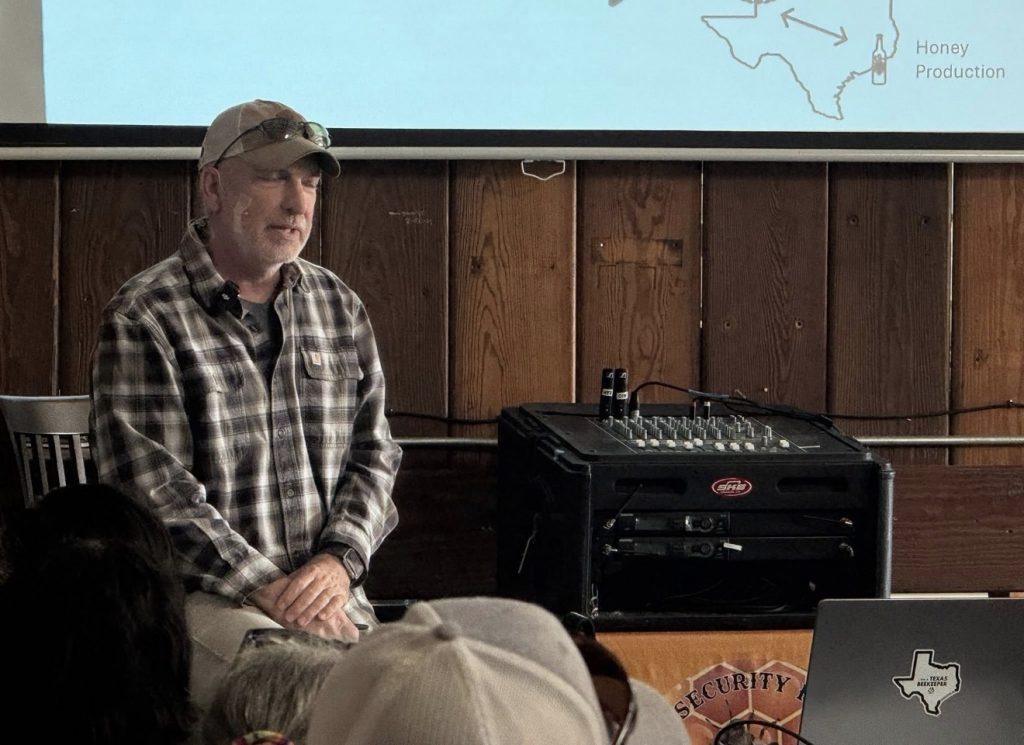
This week at our own club members Julie Norman and Kelley Jordan store Winding Creek Bee Supply. Today’s special speaker, for their weekly Spit and Whittle, was Chris Moore owner of Moore Honey shared some insight on sustainability, honey fraud and hive management.
Introduction
My transition from the corporate sector to professional beekeeping was driven by a desire for a more grounded, service-oriented vocation. Today, as a first-generation commercial beekeeper, I oversee approximately 3,500 colonies, producing and packaging honey across five Texas counties from Houston to Beaumont. This professional journey has led me to serve on the board of the Texas State Beekeepers Association, where I gained a firsthand look at the significant challenges facing the industry—specifically honey fraud, high colony loss, and the necessity of agricultural diversification.
The Reality of Honey Fraud and Market Dynamics
One of the most pressing issues for domestic producers is the prevalence of fraudulent honey. It is estimated that nearly 80% of honey consumed in the United States is imported, much of which is adulterated with syrups or misrepresented in origin.
• Labeling Deception: Many products labeled “Texas” or bearing state-sponsored marks are actually imported honey packaged by a Texas-based company. This exploits a loophole where the business is local, but the agricultural product is not.
• The Consumption Gap: Texas consumers consume roughly 62 million pounds of honey annually. However, the state’s total production often falls between 4 million and 8 million pounds. This massive deficit is filled primarily by imports, which drive market prices down and make it difficult for pure, local honey to compete.
• Legislative Needs: To protect consumers and the industry, “Truth in Labeling” legislation is essential. Ensuring that honey labeled “local” or “Texas” actually originates from within the state is a critical step in restoring market integrity.
Diversification: Pollination and Varietals
Due to the depressed price of bulk honey, beekeepers must diversify their income streams. Our operation utilizes a mobile pollination model to maintain financial viability.
Migratory Pollination
In early February, we transport colonies to Tulare, California, for almond pollination. The almond bloom provides high-protein pollen (often referred to as a “B-12 shot” for bees), facilitating a significant population build-up. We then return to Texas in mid-March to split these colonies for the honey season. In the summer, we migrate to West Texas to pollinate watermelons and cantaloupes.
Regional Honey Varietals
Honey is as diverse as any other agricultural product. Flavors and colors vary significantly by region and nectar source:
• Tallow Honey: Typical of the Gulf Coast, offering a bold flavor profile.
• Cotton and Clover: Produced during West Texas and Midwest migrations.
• Comb Honey: We have recently begun culling and selling comb to refresh hive infrastructure and maintain colony health.
Hive Management and Mitigating Losses
National colony loss rates average between 40% and 60% annually. Success in modern beekeeping requires proactive management rather than a “treatment-free” approach, which often leads to total colony collapse.
Pest and Disease Control
The Varroa mite remains the primary threat, serving as a vector for at least 13 different viruses. We employ an integrated pest management (IPM) strategy that rotates treatments to prevent resistance:
• Oxalic Acid: Effective as a slow-release pad or vapor. It has a “cleansing” effect on the brood, resulting in solid, healthy brood patterns.
• Formic Acid (Formic Pro): A strong “knockdown” treatment, though highly temperature-sensitive (ideally applied when temperatures are below 85°F).
• Thymol (Apiguard): A natural alternative effective during the summer months when honey supers are removed.
Seasonal Operations: The “Pantry” Method
During spring build-up, feeding is critical. Bees can starve even when stores are present in a “Super” if those stores are too far from the cluster during a cold snap. We emphasize maintaining the “pantry”—the area immediately surrounding the brood—with adequate nectar and pollen.
The Re-queening Cycle
Queen longevity has decreased significantly over the last 20 years. While queens once lived up to five years, many now become sterile or fail within 12 to 18 months—likely due to environmental chemical exposure affecting drone sperm viability. We recommend re-queening annually in April or May to ensure high fertility and colony vigor.
Conclusion
Commercial beekeeping is a balancing act between honey production, pollination services, and constant biological maintenance. By focusing on “Truth in Labeling” and rigorous hive management, we can continue to provide an honest, local product despite the environmental and economic pressures facing the industry.
By Chris Moore